- The Standard
- Posts
- ✍️ 2026 is coming. Most teams aren’t ready. You will be.
✍️ 2026 is coming. Most teams aren’t ready. You will be.
Steal the exact playbooks marketing leaders used to win this year.

While most teams are still staring down a blank doc titled “2026 Strategy” (no shade, we feel that pain), we’ve got a little somethin’ somethin’ for the good people of The Standard.
Presenting your 2026 unfair advantage: a roundup of the exact frameworks, templates, and tactics marketing leaders used to turn 2025’s chaos into career-defining wins.
These aren’t theoretical think pieces. You’ve got enough of those on LinkedIn.
They’re the battle-tested playbooks our SMEs—Kyle Denhoff (HubSpot), Morgan Selzer (Headspace), Hope Weatherford (Fountain), Jess Cook (Vector), and our own Emma Miller and Emily Greffenius (storyarb)—were generous enough to pull back the curtain on this year.
Here’s what actually worked when the rubber met the road, and what will give you a head start heading into 2026.


1. Stop pairing thoughtful content with mismatched offers
We’re kicking things off with a 3-step framework for matching offers to audience intent (read: not just slapping CTAs everywhere). HubSpot’s Kyle Denhoff uses the ACOM framework to identify what a reader actually needs next—which is how his team grew blog CVRs by 1,000%+ and lifted Lead-to-QL ratios across channels.

2. Find partners who amplify your reach without diluting your brand
The 2-step process for identifying and force-ranking partnership opportunities. Headspace’s Morgan Selzer built a partnership framework that evaluates collaborators by mission alignment, audience trust, and reach, so you know exactly who’s worth pursuing before you send a single pitch.

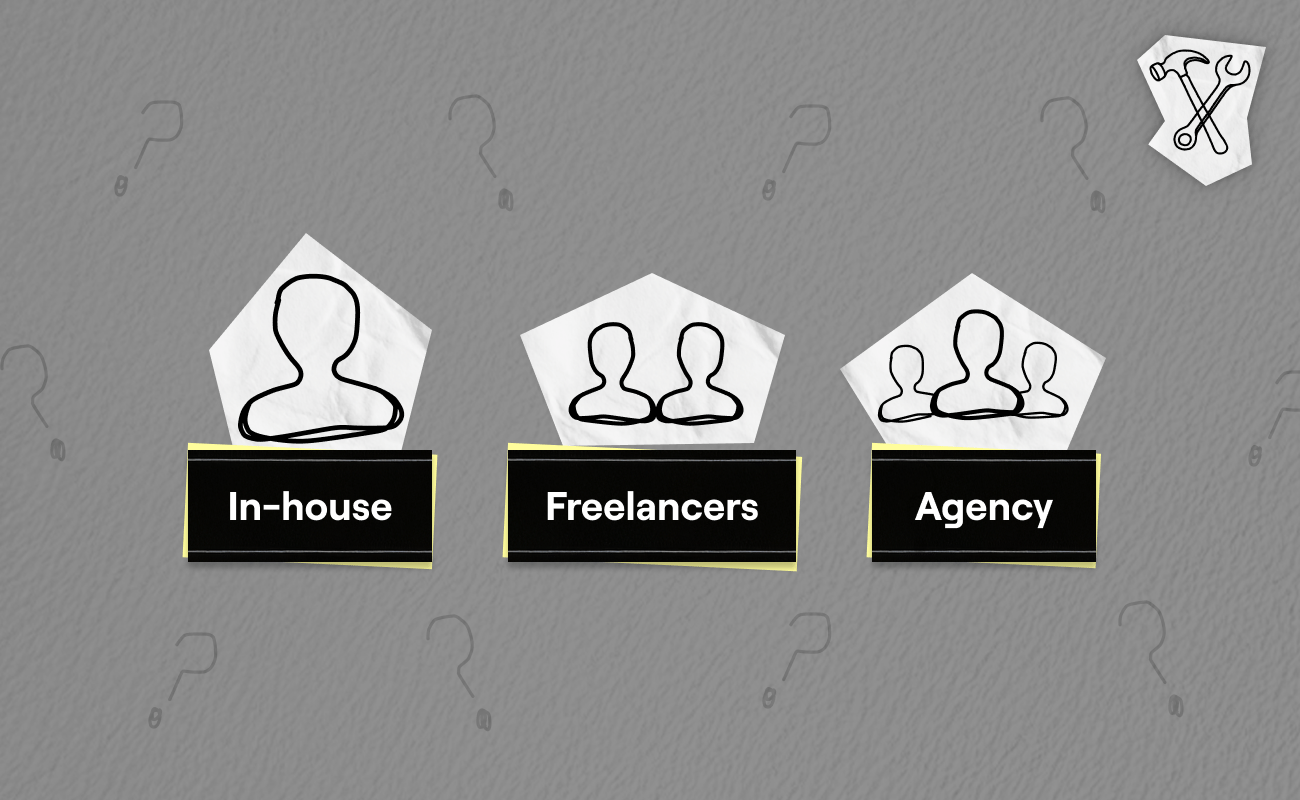
3. Decide whether to keep your rebrand in-house or bring in support
This 9-question quiz tells you if your team has the capacity, skills, and timeline to pull off a rebrand (or really, any major marketing effort). When Hope Weatherford used this diagnostic at Fountain, she quickly spotted capability gaps, staffed strategically, and 4X’d form fills in 100 days, without burning out her team.
4. Choose 3 quarterly priorities your team can execute brilliantly
A planning template that forces you to commit to 3 strategic pillars (and table everything else). This quarterly planner helps you choose:
1 proven tactic to double down on,
1 calculated bet to test,
and 1 bold experiment to run.
It’ll help your team focus on work that actually moves the needle, while giving those experiments enough time to show results.

5. Define your brand voice so anyone can speak in it
The 6-axis framework for documenting tone in language your whole team can use (AKA, brand voice no longer lives amorphously in your founder’s head). This tool helps you operationalize tone so you eliminate the “tone goalie” bottleneck and build a brand voice the whole org can scale.

6. Track what AI says about you before your CEO asks
And finally, a quarterly monitoring system for catching outdated info in ChatGPT, Claude, and Perplexity. Vector’s Jess Cook uses this approach to make sure her brand shows up accurately in AI summaries—because LLMs aggregate everything you’ve ever published, and stale content can quietly tank your positioning.


Campaigns that got us talking: Literally. Monologue is introducing a single-button keyboard for talking with your computer. The best part of this post is the comment section. People genuinely thought it was fake, which tells you the concept hit that sweet spot between “wait, what?” and “oh, that’s actually kinda smart.” When a launch sparks disbelief, you’ve broken an assumption, which is where great storytelling starts.

AI spotlight: Saying the quiet part out loud: LLMs can talk about the world, but they don’t actually understand it. The cube test (“rotate it 90 degrees, what do you see?”) is a writer’s dream metaphor. Humans visualize. LLMs guess. And now we’re all wondering: what comes after LLMs?
Stuff that made us scroll back up: This Instagram reel nails a truth we keep bumping into: half the companies slapping “AI-powered” on their homepage aren’t selling AI. They’re selling the signal of having AI. Vibes marketing.

Somewhere along the way, our industry decided the quickest way to sound “strategic” was to recycle the same limp vocabulary until it turned into dust. You could paste these words onto a SaaS platform, a candle brand, or a dental floss startup, and the sentence would read exactly the same—which tells you they’re not doing any real work. And so, we condemn to our ick list the following:
Innovative
Seamless
Authentic
Holistic
Transformational
Scalable
Robust
Impactful
Best-in-class
Disruptive
Agile
Customer-centric
Empower
Punchy (oh man, our writers hate “punchy”)

These resources are the systems that separate marketers who prove ROI from the ones who just stay busy. Together, they help you gut-check your AEO strategy, sharpen your brand voice, prioritize what actually matters, and show up accurately across AI.
Don’t learn the hard way. We’ve got your back.
See y’all next time,
— the storyarb writers’ room 🫡
Oh! And another thing… We’re tip-toeing into New Year’s Resolutions season, so thought we’d share some data. About 55% of people setting goals plan to work on a new hobby (first pottery class, first language lesson, first garden, first affiliate link in The Standard…), and we love that beginner mindset. Meanwhile only 6% of folks make resolutions to travel more. That 6% includes us, btw. Tell us where to visit you in 2026.

Reply