- The Standard
- Posts
- ✍️ marketing the unmarketable
✍️ marketing the unmarketable
“AI-powered” powers down. Try this instead.

“It’s a great day to uplevel my efficiency,” you think.
“I can’t wait to create more shareholder value,” you think.
“Surely AI can do this for me,” you think.
So you open 40 tabs.
You see every company under the sun is “AI-powered.”
Every headline promises major change.
Annnnnnd you can’t tell what anyone does from their homepage.
AI solutions have a messaging problem. It’s the same problem Alex Lieberman ran into when he launched Tenex:
How do you market yourself when the word du jour—”AI”—doesn’t actually tell anyone what you do?
Alex had some ideas.
Here’s the marketing playbook for the unmarketable product.
BTW, since we get asked a lot… Alex Lieberman, cofounder of Tenex (your AI implementation partner), is yes, that same guy who co-founded Morning Brew (your favorite business media brand), and yes again, also co-founded us, storyarb (your B2B marketer’s BFF). While we’re all very different companies, we do have a couple things in common: Alex as a founding partner with rockin’ newsletters, if we may say so.
Okay, enough family tree. Let’s get into it.


Buyers aren’t looking for a long, overwrought explanation about why your product is technologically superior. They need the SparkNotes on why product good.
If you’re marketing something new or complicated (like an AI implementation service), a familiar reference can also help, anchoring readers in something they already understand. In short:

In a world where “AI” has stopped meaning anything on its own, Tenex leaned into this equation to shape their messaging.
Earn attention with binary thinking
If your first line doesn’t stop the scroll, nothing else matters.
Binary positioning creates that interruption.

Tenex presents a clear tension: Companies that avoid becoming AI-native risk falling behind, while those that adopt it position themselves to win the next decade. The language draws a line. Some readers step toward it. Others step away. Both reactions matter less than the pause itself.
“Win the next decade” works because it hasn’t been sanded down by repetition. It still sounds like something a human would say.
Either/or language earns attention. Fuzzy language disappears.
“Healthy beef marketing”: Let references do the heavy lifting
Tenex describes itself as “McKinsey for AI.”
That phrase does immediate work. McKinsey already signals strategy, credibility, and executive-level involvement. Borrowing that reference helps buyers know roughly what kind of partner Tenex intends to be before reading any further.
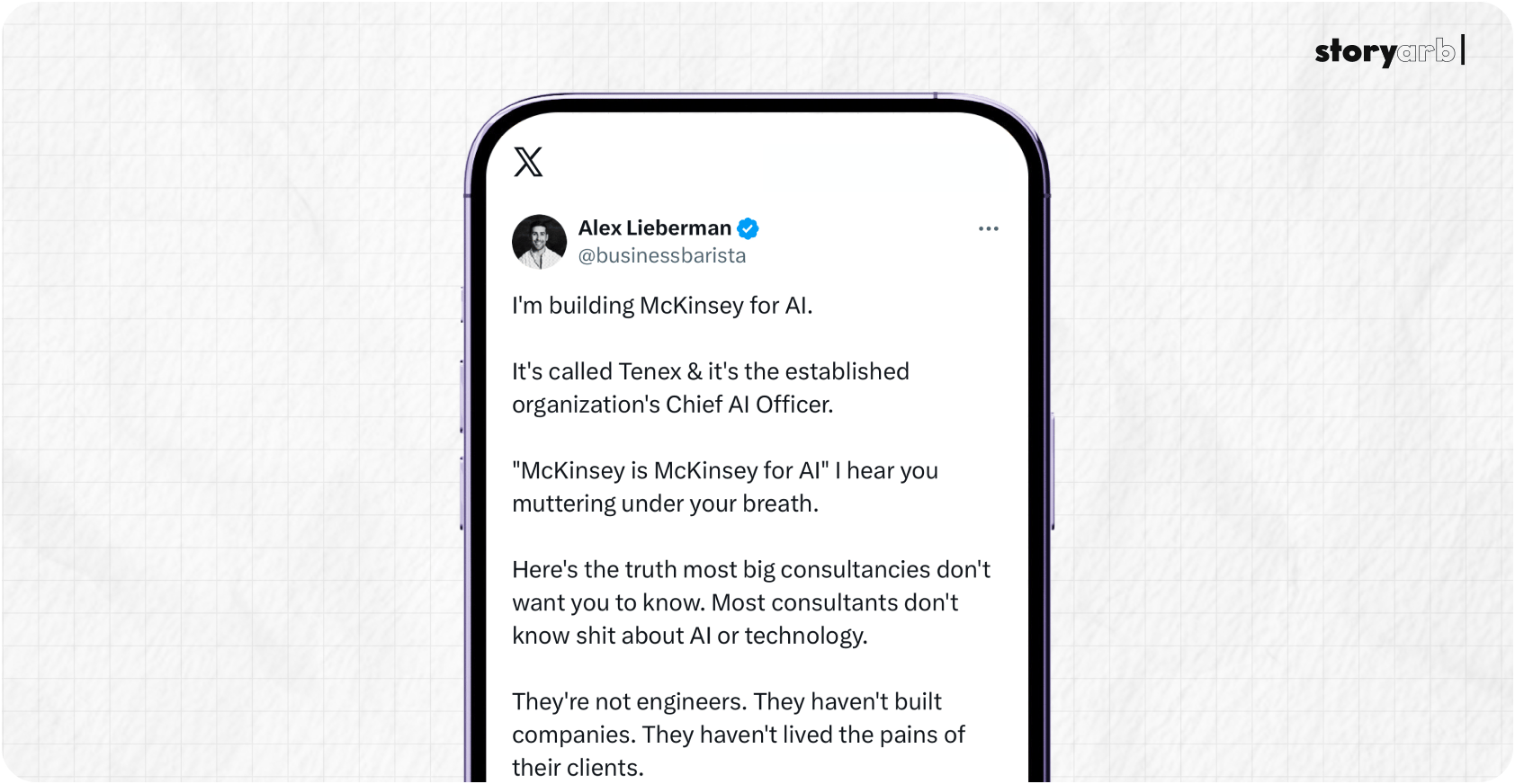
Alex calls this “healthy beef marketing.” Not conflict for its own sake, but clarity through contrast.
This tactic works best when the reference point:
Already lives in the buyer’s head
Shortens explanation time
Sharpens understanding instead of muddying it
“AI” doesn’t do anything anymore
People don’t buy tech solutions out of love for the technology. (Usually.) People buy tools to make their lives easier.
Outcomes-based messaging works because it reflects what actually matters to buyers—what the tool changes, not the how the tool works.
Tenex doesn’t spotlight features, models, or jargony promises. Their marketing skips over technical proof and keeps the attention on results: time saved, money saved, capacity created.

Testimonials focus on concrete outcomes.
A year ago, calling out AI pulled attention. Now, we’re all sick of hearing about it. Tenex bets that serious buyers can connect those dots on their own.
Playing with pricing
Tenex heard “outcomes-based messaging” and upped the ante to “outcomes-based pricing.” Here’s why.
Alex’s co-founder, Arman Hezarkhani, lived through a pivot that showed him that, with the right AI workflows in place, one engineer could perform like 50.
When output jumps that much, hourly pricing stops making sense. You can raise prices and lose buyers, or keep prices steady and sell your value short. Either way, the model rewards time spent, not progress.
With this in mind, Tenex turned toward outcomes-based pricing, a model where:
Speed of work matters more than time logged
AI has to accelerate work instead of complicating it
Clients pay for progress, not presence

And that’s how you market a real-deal AI implementation platform in a sea of fluffy pretenders.

Campaigns that got us talking: Does AI search traffic actually convert better than organic? One study says AI traffic converts better. Another says the opposite. Very “Colonel Mustard in the library with the candlestick”. Joe Lazer plays detective, unpacking why the data disagrees. Handy if AI search is creeping into your budget conversations.
AI Spotlight: If agents were the headline in 2025, then context is the plot twist in 2026. This recent LinkedIn thread reframed the AI platform debate. The real shift isn’t AI layered onto your CRM. It’s what happens when systems start learning from decisions over time.
Stuff that makes us scroll back up: AI didn’t write this performance review. It helped someone think through an entire year of their own work faster and more clearly. Big difference.

Zapier’s playbook for writing a high-impact performance review.

We’ve been deep in survey data for our upcoming AI report, and one finding keeps sticking with us: The marketing teams hitting their targets are actually using less AI language, not more.
Meanwhile, the teams under the most pressure to talk more about AI are (1) already doing it, and (2) still struggling. Almost no one is testing whether any of this messaging works, which means a lot of big positioning decisions are being made on…vibes.
We unpack what’s really going on—and what to do instead—in our Trade Secrets: Marketing “AI” in 2026 report, dropping next week.

Gdoc comments that haunt our dreams:
“Can we make this pop more?”
“Hmm”
“This feels long...”
“I rewrote this quickly — feel free to ignore.”
“Let’s punch this up.”
“Sound more human”
“This is good, but what if it were… better?”
We love collaboration, don’t we, Andrew Boulton? And a good font.

Can someone tell what your company does from your homepage?
The answer is “no” more often than you’d think. And when that’s the case, the fix usually isn’t more language—it’s grounding your messaging in references, outcomes, and a little bit of pizzaz.
We’ll dig deeper on all this in our upcoming report on marketing “AI” in 2026, where the data starts to back up some of the marketer spidey senses we’ve already had. Y’all aren’t ready for this.
See y’all next time.
— the storyarb writers’ room 🫡
Oh! And another thing... More than 8 billion conversation hearts are made for Valentine’s Day each year. While the nostalgic sugar hearts feature classic sayings like “Be Mine,” “XOXO,” and “True Love,” we have a few suggestions of our own: “Say the Thing,” “Vibes ≠ Data,” and “AI Implied.”
What would yours say?
P.S. We're hiring a Senior Editor. A little bit of writing, a little bit of editing, a lot of being the arbiter of what's actually good content. Slide into our creative director's DMs if you're interested or know someone we should talk to.

Reply