- The Standard
- Posts
- ✍️ our AI marketing survey results are in
✍️ our AI marketing survey results are in
Let’s trade secrets.

We see your AI marketing confusion and raise you a deck of data. 🤓
Lots of opinions out there on how, and where, and how much to talk about AI.
Clarity? Still playing hard to get.
All last year, we heard marketing teams ask: How do you market AI products when…
C-suites want you to talk more about AI
buyers are sick and tired of hearing about it
and almost no one is testing what actually works?
And as one marketer we know pointed out: “An ‘AI’ label slapped on a product doesn’t make it a better product.”
So today, we’re launching Trade Secrets: Marketing “AI” in 2026. Our biggest research project yet, digging into what marketers talk about when they talk about AI.
What the data suggests: Stop leading with the ingredient. Lead with the result. If “AI” disappeared from your headline tomorrow, would your value still land?


When we analyzed our survey results, the same contradictions kept surfacing across teams of every size. Not one catastrophic mistake, but four patterns quietly undermining performance.
Problem #1: Leadership wants “more AI.” Marketers don’t think that works.
Many of you (43%, in fact) are facing pressure to talk about AI more in your messaging.
Twice as many of you (83%) think that’s a dumb idea.
And you’re right! Those instincts bear out in the results. Two key trends show up for marketing teams who have struggled to hit their goals since launching an AI product.
First, most of them face significant leadership pressure to use “AI language” in their marketing.
Second, 100% of them already do.

Problem #2: We’re explaining the process. Buyers want the point.
Most marketers talking about AI focus on how it works, harping on efficiency, automation, mechanics, etc. But when asked what actually resonates with buyers:
52% say ROI and proven results matter most
…yet only 23% actually lead with those outcomes
And it’s not an easy gap to close. “The hardest part is answering: ‘Why should anyone care?’”
The shift: Make your first sentence about what changes for the buyer, not how your system works. Save the mechanics for the demo.
Problem #3: Everyone’s making big bets without evidence.
We’ve been bad.
Marketers say we love data, and yet 9 in 10 of us haven’t A/B tested AI-focused messaging against literally anything else.
That means our brand positioning decisions are driven by pressure + instinct + competitive noise—not data.
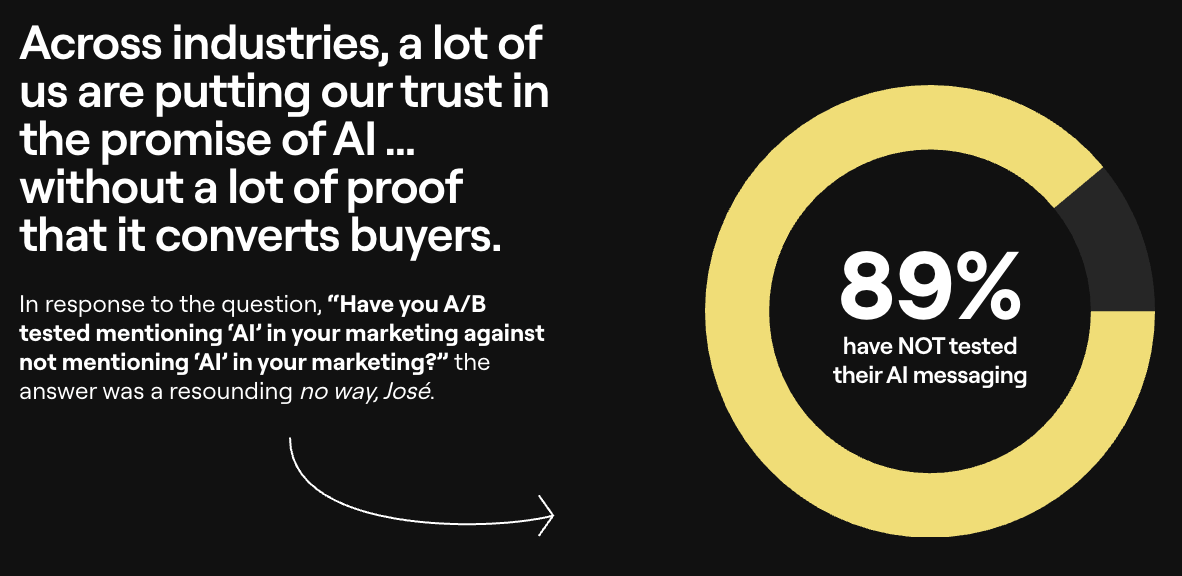
And yet, marketers rate their ability to explain value without “AI” at 7.7/10. They believe different messaging could work. They just haven’t tested it.
“We’re always told to do what our competitors are doing—but better.”
The simplest fix: Before rewriting your entire positioning around AI, test one page. One segment. One headline. Two weeks. Then let the numbers argue for you.
Problem #4: Curiosity is up. So is exhaustion.
AI marketing isn’t causing panic. It’s causing burnout. Heading into 2026, marketers said they feel:
Curious (46%)
Exhausted (33%)
Hopeful (31%)
This fatigue largely seems to stem from the mismatch between hype and proof.
We’re running experiments we don’t believe in, balancing gobbledygook from our C-suite overlords, and don’t have data on jack. Marketers still believe in the promise of AI innovation. They’re just also pretty tired of hearing nonsense.
How do we start to solve these major problems? Dig into the full report for some of our ideas.

Campaigns that got us talking: Some of us were there for the football (meh), some for the wings, the rest (hey 👋) for the ads. We’d still swap Rocket and Redfin for Pringles, though. Sorry, Sabrina.
AI spotlight: You know that friend who tells a long story and never quite lands it? That’s an LLM explaining itself. It’s not showing its reasoning. It’s generating a convincing narrative. So when an AI tool sounds persuasive, it helps to remember: that’s not insight—it’s autocomplete with a good speaking voice.

Stuff that makes us scroll back up: Disney could’ve treated AI like one of its wicked witches. Instead, the House of Mouse gave OpenAI a $1B seat at the table.

We upped the ante on a favorite childhood game: Memory.
This time, instead of matching pencils or circus tents to win, you’re matching messaging angles worth testing, pulled straight from our new report.
Flip a card to find strategies to:
Demote “AI”
Tame the chaos
Name the fatigue
Build proof, not hype
Mark your territory
Use the founder voice
…and generally stop guessing in the dark.


There’s good content, great content, and then there’s the email that makes your head tilt. Consider this a small public service announcement:
Subject line: “So grateful for you.”
Sender: a brand we have zero relationship with. If the only thing connecting us is a one-time checkout from years ago (or, honestly, nothing at all), let’s skip the emotional intimacy.

The lesson in all this is something you already know: Confusion is expensive. It’s also very, very common. Our AI report gives you the patterns, the proof, and the plays you need to find clarity instead.
Most teams aren’t testing yet. ➡️ That’s your opportunity.
Many still lead with process. ➡️ So go lead with outcomes instead.
And while others pile on AI language under pressure… ➡️ You can strip it back and show your work.
We’ll lead by example here by showing about 4 months, 3,544 scrubbed data cells, $500 of coffee gift cards, a handful of late nights, and 26 pages of our own legwork. (Possibly while singing that song from Rent.)
See y’all next time.
— the storyarb writers’ room 🫡
Oh! And another thing... This big ol’ honkin report was truly a labor of love. Also, a labor of labor. So much appreciation to (in no particular order) Julia, Olivia, Valentina, Lia, Emma, Abby, Ayo, Ari, Caitlin, Sarah, Jules, Jen, and the many marketers who took our survey.

Reply