- The Standard
- Posts
- ✍️ trust-as-a-service
✍️ trust-as-a-service
When the credible voice isn't always the marketer, finding the right SME becomes your growth strategy.

Q1 has a way of doing marketers dirty.
The 2026 plan is underway. The goals are the clearest they’re gonna be all year. We haven’t even made it to Valentine’s Day.
…and yet, it’s already been long enough to see what isn’t clicking.
One reason marketing has felt so hard lately (it’s not only us, right? 😅) is because a lot of us are trying to sell products that have never existed before. The AI boom unlocked this flood of innovation—annnnd no one really knows how to talk about the results yet. Your buyers included.
It’s damn hard to sell something that’s never existed before.
But that novelty can also bring some major opportunity.
Case in point: Nick Lafferty, Head of Growth Marketing at Profound, a platform that helps businesses show up in AI search. (AEO: something that notably didn’t really exist until about 10 minutes ago.)
Working in this emerging space, Nick realized that buyers needed significant education before they were ready to sign on the dotted line.
This week, we’re showing you how he took ‘em to school. 🎓️

Profound’s audience had a problem.
Specifically, it was that they were being told to “figure out AI search visibility” when no one had explained:
what AI search visibility actually was
how it differed from traditional SEO
or how teams should evaluate solutions in a category that barely existed yet.
Nick didn’t solve this by shipping more campaigns. He changed how Profound helped buyers make sense of the category itself.
Here’s the system he built:
1. Let a trusted SME own the narrative.
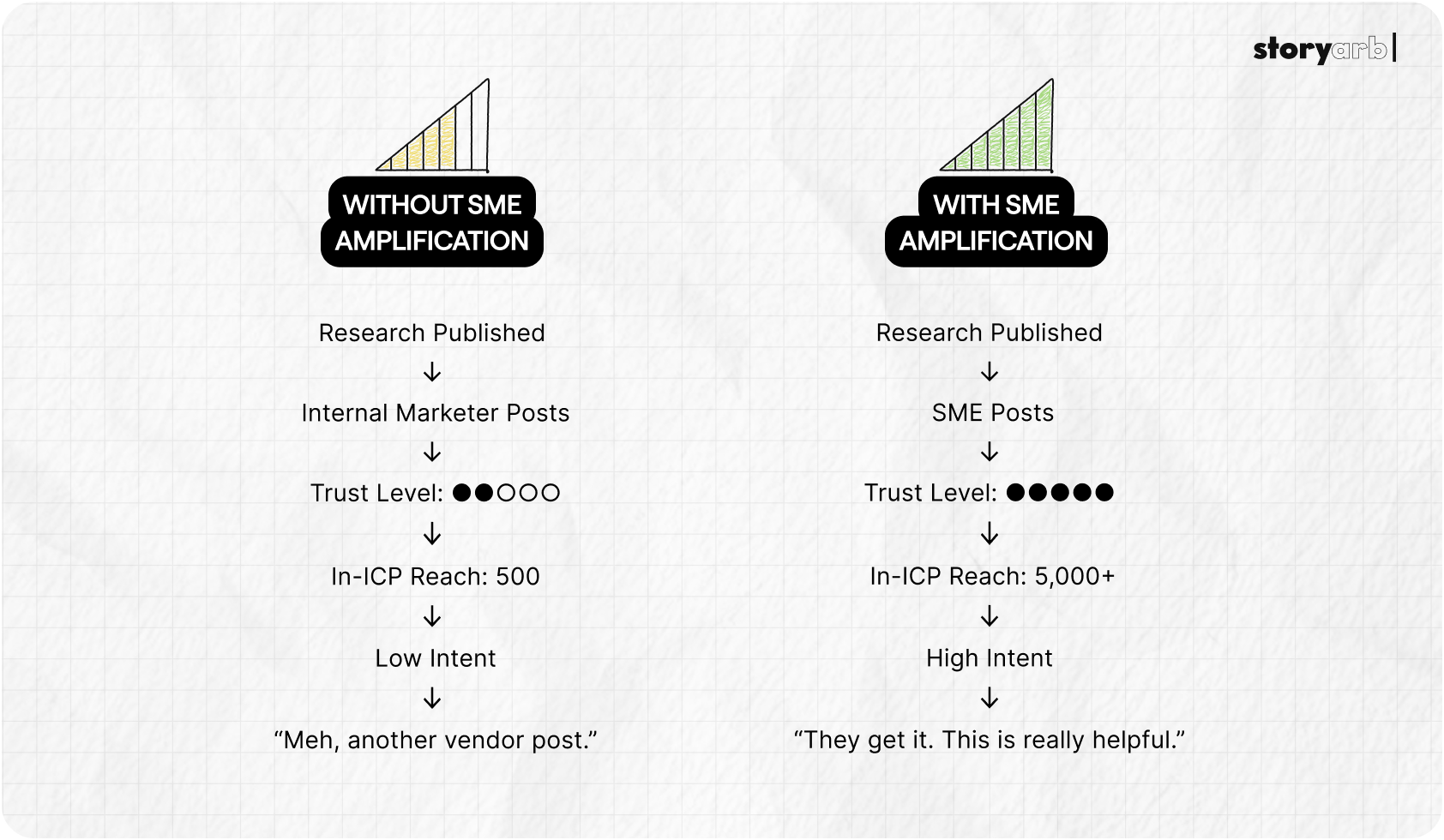
Instead of starting with his own thought leadership, Nick identified a colleague whose technical depth and audience already matched Profound’s ICP. Josh Blyskal, who leads AI strategy and research, became the primary voice sharing the company’s proprietary research and defining the category.
2. Make original research the backbone of your content strategy.
Profound committed to publishing original research on a steady cadence, sharing insights buyers couldn’t get anywhere else. The goal was to give prospects something concrete they could reference in their own internal conversations about AI strategy and budget.
3. Distribute, then redistribute.
Each research drop fueled LinkedIn posts, sales conversations, conference talks, newsletters, and earned media. Nick stopped obsessing over channel-level attribution and focused on one signal: Are buyers showing up to sales calls more informed?
The outcome was better conversations with buyers who now had the context, clarity, and confidence to evaluate Profound’s solution before sales ever entered the picture.
That’s how Profound went from selling into a new category to becoming the default reference point for it.
Check out the full playbook of Nick’s trust-building flywheel. (aka, how to help those buyers who are still figuring out what on earth it is y’all do)

Campaigns that got us talking: Atlassian launched a new spot for its Teamwork Collection that opens like a classic enterprise testimonial… then swerves hard. Enter Zach Woods from The Office. It’s awkward. It’s intentional. And you’ll leave wondering about “Shared Goalz’s” album.
AI Spotlight: Anthropic (you may know them as Claude) is reportedly raising $10B. The signal: We’re watching a handful of AI platforms move from “interesting tools” to “the thing you open first.”
Stuff that makes us scroll back up: Somewhere along the way, B2B decided that “enterprise” means “boring.” It doesn’t. People don’t lose their sense of humor, emotions, or scrolling habits just because they work at a big company. The brands that stand out talk to enterprise audiences like actual humans, not faceless committees.

We asked the team what keeps them here. The answers were different, but the theme was consistent:
“Writing is such a solitary act—but here, you get to do the lonely parts together. You suffer through the first drafts together. And you celebrate the final ones together.” — Nish, Copywriter
“I’ve never worked anywhere where you can roll up your sleeves, build from scratch, and actually do the work. That’s where I’m happiest.” — Valentina, Operations Manager
“We get to have real conversations, with each other and with smart people outside the company. It feels like being a journalist, just not in the way I expected.” — Morgan, Senior Content Strategist
“Our clients care about content. They invest in it. They trust us with real insights about their businesses, and we get to tell those stories well.” — Shaye, Customer Success Manager
That’s the job, more or less. Do the work. Talk to smart people. Make something worth reading.
If that sounds like your speed, we’re hiring.


Kerri Amodio’s amazing list of marketing icks is something we can’t unsee. You’re welcome. Or sorry. You choose.
Homepages that don’t explain what your product does or who it’s for
Asking for a phone number on forms
Brands trying too hard to hop on social media trends
Homepages that don’t explain what your product does or who it’s for
Getting retargeted by companies you’re already a customer of
Overdone swag—we have reached Yeti cup saturation
Homepages that don’t explain what your product does or who it’s for
Glad it’s not just us, Kerri.

When you’re building something new, buyers need education before they need the sales pitch.
Ads aren’t designed to do the heavy lift of education. Jargony product pages don’t convert. And no amount of budget fixes a fuzzy narrative.
So go deeper. Pass the mic to subject matter experts, publish your own findings, and when you have something important to say, say it on every. single. channel.
See y’all next time.
— the storyarb writers’ room 🫡
Oh! And another thing... While the ’arb’s favorite Super Bowl noshes vary (Team Buffalo wings, anyone?), the economics of attention are harder to ignore. A single 30-second spot in the 2026 game now runs around $8 million—more than 200× the cost of the same airtime in 1967. When attention costs that much, authority starts to look like the better long game.

Reply