- The Standard
- Posts
- ✍️ what’s going on with marketing layoffs?
✍️ what’s going on with marketing layoffs?
AI panic drove 2025’s backwards layoffs. Here’s what marketing leaders need to protect (and cut) heading into 2026.
This year, storyarb had a front-row seat to some pretty seismic shifts in the marketing-verse.
First, we sold out our Q1 onboarding seats in 30 days.
Then, we watched our entire pipeline get laid off within 4 weeks.
It was something we’d never seen before. Heads of Marketing, at $10M+ B2B companies, with approved budgets, getting cut—or at least weathering some pretty intense AI-driven reorgs from the powers that be.
More on what the ever-loving f*** is going on in our industry below.
(Deep breath.)
🦃 🦃 🦃
Okay. Before we dive into the AI chaos, in the spirit of the holiday, let’s also channel some gratitude as we gather ’round our turkeys.
A few things keeping us optimistic:
The marketing leaders who bring us along with them throughout their career journeys (even as they move from company to company).
All of you who subscribe to The Standard. Our team writes a lot of newsletters. This one is our favorite. 🥰
The “schedule post” feature that lets us log off during the holidays.
Now let’s eat.


Our CEO, Abby Murray, has surfed a marketing hype wave or two. 🌊
As marketers navigate layoffs, new strategic directives, and career transitions, we grabbed her take on the state of our industry heading into 2026.
TL;DR: 2025’s marketing layoffs were driven by AI panic, not economic caution. In 2026, we bet a lot of companies will regret these decisions as they realize AI wasn’t the magic innovation bullet they assumed it was.
Over to you, Abby:
How were 2025’s layoffs different from previous cycles?
Historically, layoffs in our sector have stemmed from economic downturns (or fear of one to come).
Markets tighten → budgets shrink → teams get cut.
But 2025 was not that. Instead, cuts stemmed from the pressure to look “AI-efficient” ASAP.
I recently chatted with an in-house marketing leader at a tech company who experienced exactly this: full sales pipeline, fully approved Q2 budget, then the whole team was laid off.
We heard the same story over and over this year.
Teams with approved budgets, healthy pipelines, and greenlit plans got cut before budget reductions even hit.
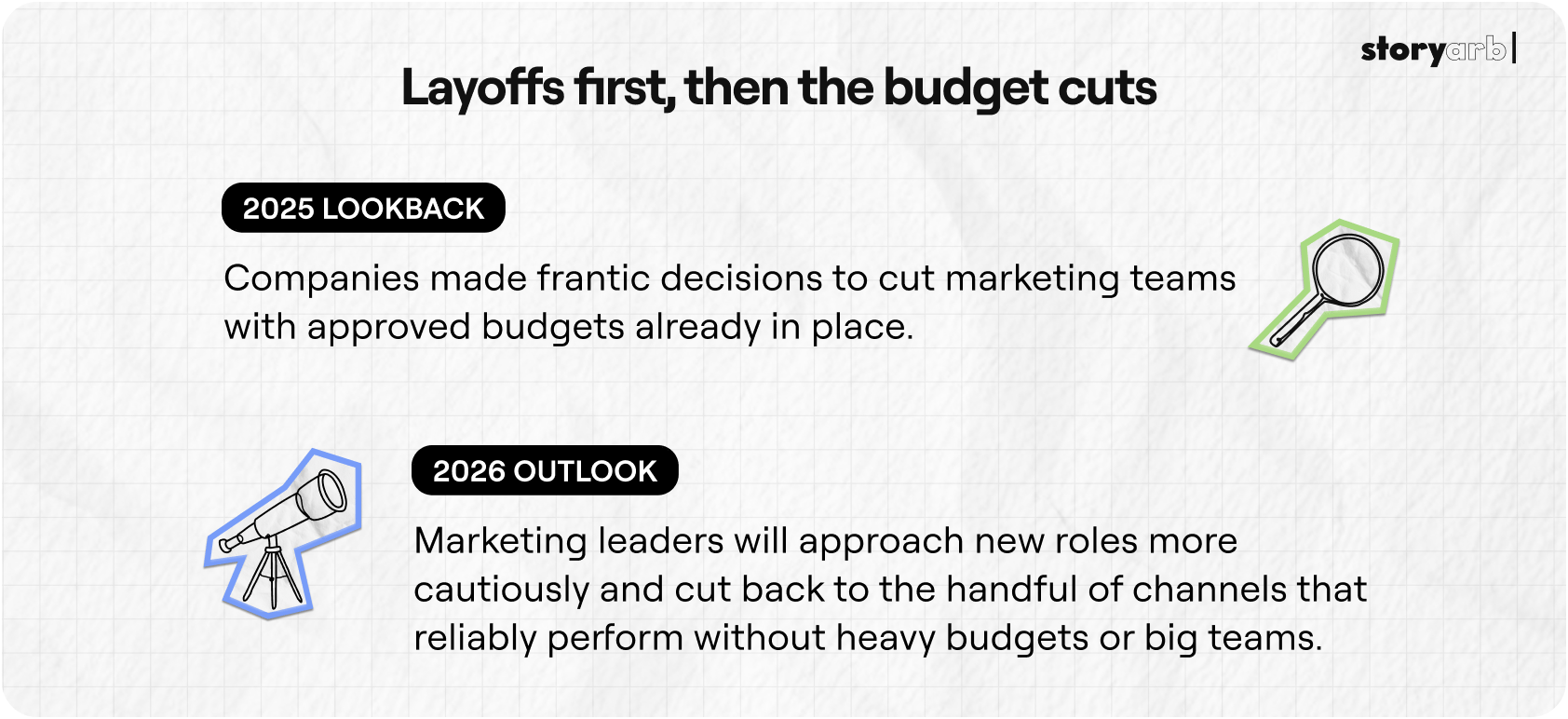
Rather than reacting to fear of an economic downturn, execs were fueled by AI hype and the pressure to move “faster, cheaper, automated.” Cuts felt frantic and rash as companies struggled not to feel like they were falling behind.
With leaner teams and a diminished sense of stability, marketers in 2026 will lean into reliable, proven tools and tactics to prove their ROI.
What drove companies to make these cuts so quickly?
AI panic made us all a little cult-like in our beliefs. I think companies that leapt to layoffs often found themselves stuck on these two unshakeable doctrines:
“We must adopt AI immediately, or perish.” (e.g., their role was at stake)
“We must eliminate ALL inefficiencies and replace headcount with AI immediately, or perish.” (e.g., their company was at stake)
The stakes felt incredibly high, the solution felt incredibly simple—fire people and replace them with AI—and the aftermath is going to hurt real bad.
We’re talking multiple rounds of layoffs at the same organizations, layoffs at companies that have been historically immune to them, and longstanding marketing leaders forced into new roles and responsibilities. All as speculation about the AI bubble popping gains traction.
A mess.
Now, reality is setting in as companies realize: AI is great for speeding up workflows, but not mature enough yet to fully replace headcount. It still requires a lot of human context and judgment to get quality output.

What budget line items are smart companies protecting at all costs?
Welcome to my favorite soapbox.
First: the “why” behind the budget.
👉 In 2026, you need to answer the questions your customers are asking. Selflessly. That’s it. 👈
That means providing consistent value-add resources that help them be better at their jobs. It means writing headlines and subheaders and body copy that speak to their FAQs. It means structuring your website to be readable.
Writing 101 stuff, right?
So as far as budget, invest in whatever you need to get that done for you. You need your website to run smoothly (developer resources). You need your content to look good on the page (design resources). You need the words to be well-written (copywriter resources).
If you don’t have them in your budget sheet already, I’ll add that thought leadership and founder social should be a line item for sure. Not including them would be a huge miss. (At least 20% of storyarb’s pipeline comes from my and Alex’s LinkedIn posts.)
As far as things to cut, SEO + SEM are a completely different ballgame now and don’t require the investment they used to. AEO is worth some attention, but don’t listen to anyone who tells you it’s wildly expensive to execute a strategy here.
Finally, I firmly believe there will (and should!) be an increase in IRL events and relationship-building.
There’s a growing craving for in-person interactions, and even small touchpoints—an intimate CMO dinner to support ABM strategy, getting 1:1 facetime with your client (off Zoom) to improve retention and communication—will play an important role in supporting long-term company health.
But apply carefully. IRL can become incredibly costly in both time and money. So smart marketers will advocate for the right events, not the biggest.
(And on that note…anybody want to hang out? We’re in NYC, Philly, LA, and Chicago, and planning where to spend IRL time with our readers in 2026. Drop a pin…by replying to this email.📍)


Campaigns that got us talking: ChatGPT’s latest brand campaign is looking a little less “A Space Odyssey” and a little more “AI at your dinner table.” Rather than lean into the futuristic aspects of AI, it’s highlighting cozy, everyday scenarios where you might use prompts for things like dinner date inspo. (Rather than, say, prompts for replacing your entire creative team in an “efficiency play.”)
AI spotlight: As the conversation about AEO best practices continues, we think this brand and GTM founder has pretty great taste. (We love seeing our team’s insights spark a bit of conversation!)
Stuff that made us scroll back up: Speaking of AEO: Super co-founder Lindsay Liu is experimenting with what she calls “social proof via LLMs (don’t just take it from us…ask your AI BFF of choice).” The AI assistant for property management links to popular LLMs at the bottom of their site, with pre-set prompts that speak to customer pain points.

h/t Casey Hill

You can’t prove pipeline if you don’t know who’s engaging with your work.
Our recommendation if you’re stepping into a new marketing leadership role in 2026? Get a de-anonymized reporting platform up and running, stat. These tools tell you who’s visiting your website, no gates or form-filling required.
We use these tools (bundled with a couple others) internally to run our “final-mile” playbook. The simplified version:
We see who’s interacting with us in multiple places (reading multiple pieces of content, signing up for our newsletter and connecting with us on LinkedIn, etc.) or visiting high-intent pages of our website (like Pricing)
We scrub and enrich that data to identify which of those folks are in our ICP
We reach out to those people directly to make connecting with us hassle-free
If you’re a storyarb client, we’re going to do this exact thing for you with our new Leads Report, which we’re piloting for rollout in 2026.
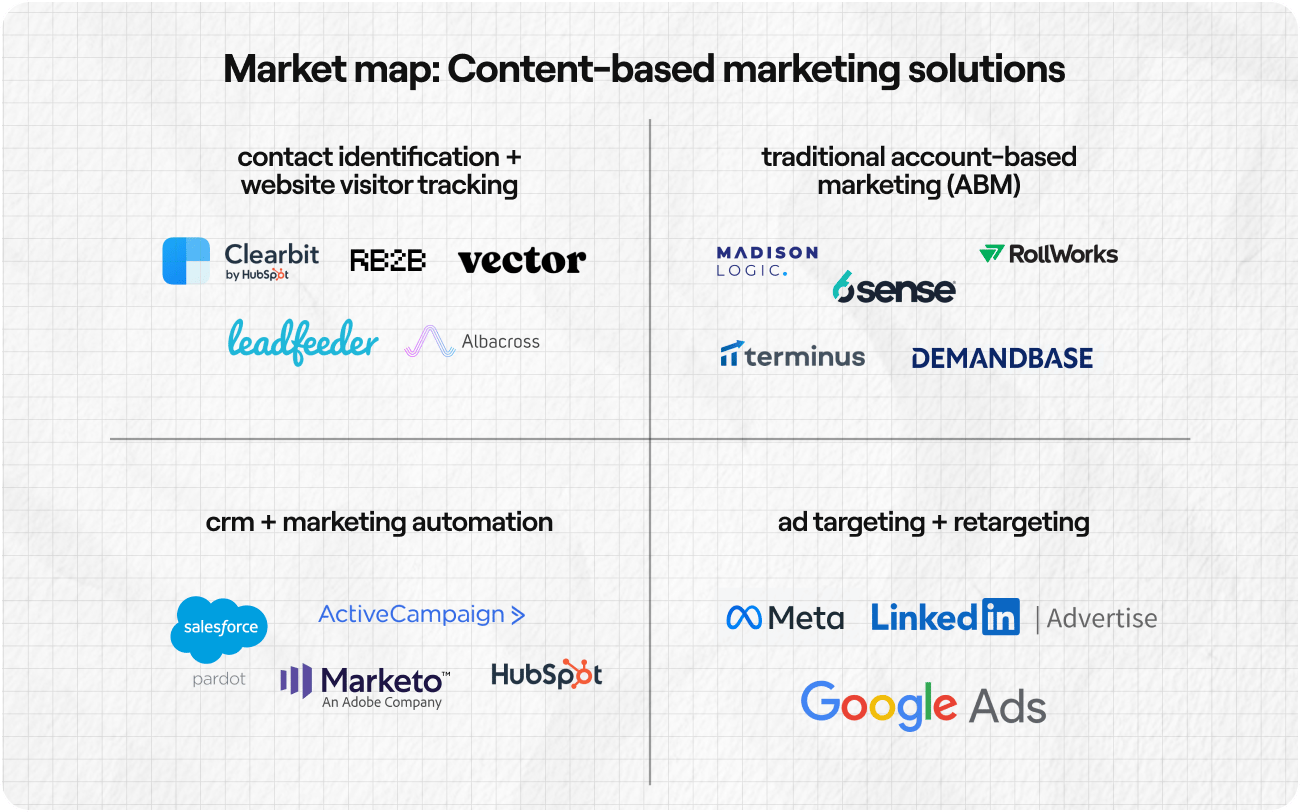
Or, if you want to DIY your own process, we outlined a few useful tools in the contact identification + website visitor tracking section of this marketing map:

As we head into the busy holiday season, our team’s new stress relief tactic is kvetching in public. Here are the marketing trends we take umbrage with this week:
Case studies that follow the format: “Client was dumb and bad. Then they spent $400,000 on our AI solution. Now Client is crushing it!” …with zero receipts.
Thought leadership written by committee until the message collapses under the weight of its own approvals.
“Annoyance economy” tactics where the goal is to run ads so obnoxious subscribers pay to get rid of them. (Lookin’ at you, 10 unskippable YouTube ads.)

2025 was the year marketing got caught in AI’s hype cycle—frantic layoffs, backwards budgeting decisions, and a whole lotta messy reorgs.
But marketers are resilient, and we’re keeping a close eye on what the folks in our orbit do next.
For one thing, marketers are increasingly becoming part of the solopreneur and fractional work trends as they look to de-risk their careers and take more control over their paths.
One laid-off marketing leader we know started a personal newsletter and is building her own audience. Another transitioned from running marketing at a multibillion-dollar company to become a co-founder at an early-stage startup. Both leaned into non-traditional paths.
Platforms like beehiiv (which we use to send this very newsletter, btw) are popping up with tools to support solopreneurs and creators, and marketers are a big part of that story.
Those who avoided layoffs, but are still navigating big changes in-house, will see a shift back to basics as they head into 2026 with smaller, scrappier teams than they started with in 2025. We’re seeing more companies add agencies to their org charts to avoid adding headcount. They’re tapping into the efficiency of a team of specialists at the same cost (and reduced risk) of a single in-house hire.
In closing: Marketing leaders should balance their proven marketing mix with a desire to get fluent in newer tactics. Foundational initiatives with straightforward, proven value—like thought leadership, founder-led content, and de-anonymization tools—will be appealing bets in this new era. Plus AEO sprinkled over all of the above.
(Deep breath. Again.)
Here’s to new beginnings.
See y’all next time.
— the storyarb writers’ room 🫡
Oh! And another thing… If you like to think big (literally) and have $190K to throw around, that’s the estimated cost of constructing a new balloon for the Macy’s Thanksgiving Day Parade. That number falls to $90K to re-inflate an existing balloon. You gotta admit, 35 blocks down 6th Avenue (and ~30 million viewers) is one hell of a marketing pipeline.

Reply