- The Standard
- Posts
- ✍️ Alex Lieberman says you’re wrong about AI
✍️ Alex Lieberman says you’re wrong about AI
Why companies get stuck in Phase 1 of AI implementation.

Most companies think they’ve “adopted AI” because half their team has a ChatGPT tab open.
We think that’s absurd.
Alex Lieberman, our co-founder and resident AI whisperer, has seen the same pattern over and over:
→ A company sees its employees using ChatGPT or Claude successfully, and thinks, “we oughta scale that”
→ They decide to integrate AI into their workflows, expecting a magic bullet and insta-savings 💸
→ Sometimes there is a step here where they fire a whole bunch of people for “efficiency” reasons
→ They don’t devote the time and people resources true AI integration into workflows needs
→ Chaos ensues
→ They get frustrated and blame the technology for being “not there yet”
We hate to say it, but if this sounds familiar, it’s on you—not the tech.
Think of bringing in new AI tools like onboarding junior employees.
They have the skills to help do the foundational, time-saving work that makes your job easier. But to get them there, you have to purposefully onboard them into your systems, data, resources, and culture.
Last week, we handed the mic over to Abby to talk marketing layoffs. This week, we’re calling in Alex to give us the skinny on what businesses get wrong about AI, and how marketers can turn AI into genuine leverage—not just a tired fad.


There’s been plenty of ink spilled about how AI is going to take marketing jobs.
We think a more useful frame is: AI is a helluva gift for the under-resourced marketer.
(We’ve also never met a marketer who says they have more than enough resources.)
TL;DR: Marketing leaders who can bake AI into their workflows by rebuilding processes from the ground up will be invaluable in the “AI hangover” era. The shortcut is a lie. Lean into the slog.
All you, Alex.
What was overhyped about AI in 2025?
Everyone touted 2025 as “the year of AI agents”—self-guided, autonomous AI entities completing tasks without human intervention.
We aren’t there yet.
AI agents are what I’d call a “Phase 4” transformation, while most companies right now are firmly grounded in Phase 1.
Let me break it down for you.

1. Single-player tools, where employees are using off-the-shelf solutions like ChatGPT or Cursor. This is where most companies are.
2. Single-player processes, where an employee bakes AI into a process. Example: Say you have someone in accounts receivable physically turning every single bill into an invoice, sending it to the customer, then manually following up. You could help them win back 80% of their time by bringing AI to that process.
3. Multiplayer processes within a single function of a business. Take your sales process. An SDR does outreach, then they hand leads over to account executives who start their own process to convert. Rearchitecting this process and handoff to be AI-driven is a multi-person endeavor, but limited to a single function.
4. Multiplayer processes within multiple functions of a business. This would look like using AI to help your paid marketing org run paid ads while working hand-in-hand with your designers to constantly rotate in new creative. The rewards are high, but this is playing AI transformation on hard mode.
At my company Tenex, a consultancy helping companies go AI-native, we don’t recommend even attempting Phase 4 until you are crushing it on 1–3.
Why are companies struggling to move beyond Phase 1 AI adoption?
When you ask someone to try drafting in Claude instead of Google Docs, that’s easy peasy.
One action, one person. Lemon squeezy.
If you’re trying to bring AI into “multiplayer” tasks, like rebuilding your entire SDR outbound process, you’ve got a bigger hill to climb.
That requires changing workflows, documenting processes, getting buy-in across teams, and dealing with different cultures around AI adoption. Things get exponentially harder with each step and each person you add.
The reason AI implementation fails so often is because businesses don’t know—or maybe they don’t want to know—that it is a full-time job to rebuild your processes to bake in AI.
A lot of 2025’s disillusionment with AI came from companies expecting plug-and-play transformation. In reality, becoming AI-first requires hundreds of hours of rebuilding workflows.
Again. Embrace the slog.

Where should marketing leaders actually focus their AI efforts in 2026?
I love this question, because I think after engineering, marketing is the function where AI can create the most leverage right now.
One of the most valuable emerging use cases I see is in account-based marketing and enrichment—what Abby calls “the final mile.”
Picture this: An agent combs through your newsletter opens/clicks, LinkedIn profile views, and website engagement for a given week. It enriches those people’s information (who they are, where they work, company size, job title, location, etc.). It turns that enriched data into a leads list. It creates customized email drafts with you as the human in the loop to edit and approve. Then it automates outreach.
We’re not far from being able to do most of this—in fact, it’s something we’re beta testing for storyarb clients right now—and it can make outreach incredibly personal at incredible scale.

Now for our lightning round. What are the biggest mistakes you see companies make when it comes to AI adoption?
Companies that cut marketing teams thinking AI would replace them in 2025 are going to be hurting in 2026. They’re realizing they need their marketers to lead the AI charge, but now those marketers are stuck in survival mode, not transformation mode.
Should marketing leaders bet on their products or their process?
Product first, always. If you’re a marketer at a company with an AI product that over-promises and under-delivers, you’re playing a losing game. You can drive people in the door, but retention will be horrible.
Where can marketers go to get smarter about AI?
Two recs here: HubSpot’s “Marketing Against the Grain” podcast with Kit Bodnar and Kieran Flanagan and Greg Isenberg's YouTube channel for building agentic workflows specifically for marketers.
Do you have a marketing prediction for 2026?
It won’t be a marketing advantage to say you’re an AI company or call out your AI capabilities anymore. It’s a tired approach for companies to market as “We are the AI ERP,” “We are the AI CFO,” etc. People have spent the last year trying out shiny new AI tools and seeing them come up short, and they’ll be a lot more wary in 2026 than they were in 2025.

Campaigns that got us talking: Our NYC-based arbonauts have been noticing Clay’s subway ads, but we like this story even more. Clay’s co-founder asked finance for Super Bowl tickets. The Head of Finance walked him through the math behind his answer. (We love this kind of founder-led content: One part real relationships meets one part real expertise.)
AI spotlight: What’s in your “emotional support tech stack”? A refreshing take on the qualitative dimension of AI, and how it can make work tasks more sustainable (and less tumultuous).
Stuff that made us scroll back up: This warm-and-fuzzy LinkedIn exchange between Abby and our CoS Lauren—a primer on everything you need to know about the never-ending value of a Chief of Staff who does it all.

Last month we sent out our 2026 AI Marketing Survey, and now we are deep in the data analysis. 🤓
Full findings coming your way in January, but thought we’d share a few interesting tidbits from our respondents as an early treat. Here’s how your peers are thinking about AI in their 2026 messaging:
“An 'AI' label slapped on a product doesn't make it a better product.”
—Marketing director at an AI-native commercial real estate firm
“Talking about [our] AI product isn't hard, but the higher ups emphasize copying the messaging of bigger brands, which undermines our message and makes it generic.”
—Marketer at a 500+ person health org that started rolling out AI products in the last year
"I'm less concerned about AI marketing itself than I am about marketers who are relying on AI to think strategically for them. That creative ceiling is very low...I can see the low ceiling better than I did a year ago."
—Marketing manager at a growth-stage martech company
“[AI is] soooo boring. If someone can sell me a genuinely interesting use case of an AI product that isn't a chat bot or a thing that organizes your inbox or summarizes something, I'll eat my hat.”
—Marketing manager at a 500+ person HR tech co that started rolling out AI products in the last year 🎩
Early impressions? Agree? Disagree? Hit that reply button and spill.

A glance at the content marketing trends going on our naughty list this year:
Fake brand apology letters. The only thing you have to apologize for is jumping on this tacky trend.
Editors whose only feedback is “make it spiky” plus three gdoc comments that are just question marks.
“[AI company]’s latest update renders all the writers in the world obsolete” LinkedIn posts that are clearly written by AI.

The AI expectation in 2025: AI is an amazing shortcut!
The AI reality in 2026: There are no shortcuts.
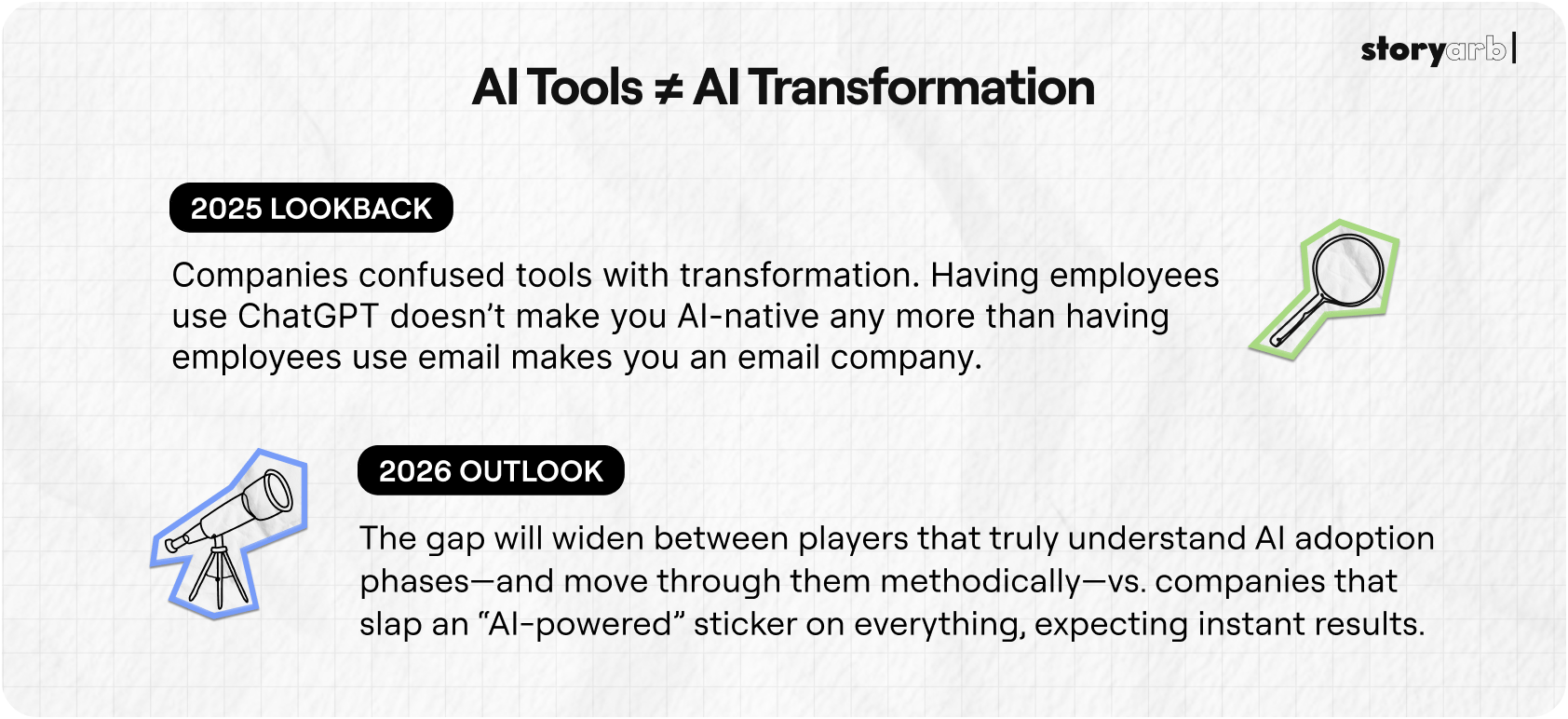
The gap between companies that treat AI like a magic bullet and companies that methodically overhaul their workflows is about to become a canyon.
Those who dedicate real resources to rebuilding processes for AI—not just buying one-off tools—are poised to see the 10x gains the technology can bring. The rest will be left asking ChatGPT, “Why didn’t this do anything?”
See y’all next time.
— the storyarb writers’ room 🫡
Oh! And another thing… In the ‘50s and ‘60s, Philadelphia police used the term “Black Friday” for the day after Thanksgiving because traffic jams, packed crowds of shoppers, and the Army-Navy football game made for a grim, exhausting workday. Later on retailers reclaimed it, popularizing the narrative that Black Friday was the day stores went “into the black” (turned profitable) after being “in the red” earlier in the year. We love a rebrand moment.

Reply